
TroubleshooterA few questions, then an urgency level and next steps
Ceiling Water Stain Troubleshooter
A wet ceiling near light fixtures or outlets is an electrical hazard: act now. Otherwise find the source, dry the area within 24-48 hours and watch for mold, which you can clean yourself only if it is small.
On this page
Ceiling water stain: what to do first
A few questions about what you can see, ending in how urgent it is and what to do next. It does not diagnose your roof or plumbing. For that you need someone to look at it.
Is the ceiling wet, dripping or actively leaking right now?
Yes, it is wet or dripping
Is the wet area around a light fixture, ceiling fan, outlet or any other electrical equipment?
Yes, or water is dripping near electrical equipment
Act now
Treat it as an electrical hazard
Water and electrical equipment do not mix. Do not touch switches, fixtures or equipment near the wet area, and do not stand in water to reach a panel.
What to do
- Turn off power to that area at the main panel only if you can reach it from a dry spot. If you would have to stand in water, call an electrician.
- Have an electrician check the wiring and equipment before you use it again.
- Catch dripping water in a container and move belongings out of the way.
- Photograph the ceiling and the leak before anything is moved or repaired.
No
Where do you think the water is coming from?
A guess is fine; the point is to point the right professional at it.
A pipe, appliance or bathroom fixture above
Deal with it soon
A plumbing leak: stop it, then dry it
Fix leaks as soon as you can and dry wet materials quickly. Wet drywall and ceiling materials that stay wet for more than 24 hours can grow mold, and the target is to dry them within 24-48 hours.
What to do
- Stop the water at its source: shut off the supply to the fixture or appliance, or the main supply if you can't tell which.
- Call a plumber to find and fix the leak.
- Photograph the damage before repairs, and call your insurer if the leak was sudden.
- Dry the area with open air, and fans or a dehumidifier once the electrical equipment nearby is safe. Clean any visible mold first.
- Throw away ceiling tiles or other porous materials that cannot be cleaned and dried.
The roof or an outside wall
Deal with it soon
Water from the roof or walls: get the opening covered
Water coming in from outside needs the opening covered quickly, a temporary repair first and a permanent one later. This page cannot tell you where on the roof the water is getting in; a roofer can.
What to do
- Cover the opening if you can reach it safely from the ground or inside. Do not climb onto a wet roof.
- Photograph the stain and the outside before any repair, then report it to your insurer if a storm caused it.
- Keep temporary repair receipts; hold off on permanent repairs until the insurer has inspected.
- Get written estimates from licensed, insured roofers before choosing one.
- Dry the wet ceiling and insulation promptly so mold does not start.
Condensation or humidity, such as cold pipes, a bathroom or the attic
Keep an eye on it
Moisture from condensation: fix the moisture, not just the stain
Condensation forms where warm, humid air meets a cold surface. EPA's advice is to keep indoor relative humidity below 60 percent, ideally between 30 and 50 percent, to vent moisture sources outdoors, to run bathroom fans, and to insulate cold pipes.
What to do
- Run bathroom and kitchen fans, and vent dryers and other moisture sources outdoors.
- Insulate cold pipes and improve air circulation where condensation forms.
- Use a dehumidifier or air conditioning if the air stays humid.
- Clean any mold, then dry the area. Do not paint over a damp or moldy stain.
- If it keeps coming back, have someone look at the attic and ventilation.
I can't tell
Deal with it soon
Unknown source: treat it as active until proven otherwise
If you can't tell where the water is coming from, the safe move is to limit the damage and get someone qualified to find it, because every day it stays wet raises the odds of mold.
What to do
- Photograph the stain and its size, and mark its edge with a pencil so you can see whether it grows.
- Check the room above and the roof area above it for plumbing, an appliance or an opening.
- Call a plumber or a roofer, or both, depending on what you find.
- Start drying the area, and report the loss to your insurer if it looks sudden.
No, the stain is dry
Is there visible mold on or around the stain?
No visible mold
Keep an eye on it
A dry stain: find out whether it is old or still active
A dry stain with no mold may be from a leak that has stopped, or one that comes and goes. The key to controlling mold is controlling moisture, so you want to know the water is really gone.
What to do
- Mark the edge of the stain with a pencil and check it after the next rain or the next time the plumbing above is used.
- If it grows or turns damp, treat it as an active leak and use this page again.
- Do not paint over it until you know the water problem is fixed and the surface is dry.
- If it comes back, photograph it each time; the record helps with an insurer or a contractor.
Yes, there is visible mold
How big is the moldy area, and where did the water come from?
EPA's rule of thumb is about 10 square feet, roughly 3 ft. by 3 ft.
Smaller than about 10 square feet, from clean water
Deal with it soon
Small mold: most people can clean it themselves
For a moldy area smaller than about 10 square feet, EPA says most people can do the cleanup themselves. The water problem has to be fixed too, or the mold returns.
What to do
- Fix the water source first.
- Wear an N-95 respirator, sealed goggles and non-latex gloves.
- Scrub hard surfaces with detergent and water, then dry them completely. Never mix bleach with ammonia.
- Throw away ceiling tiles or other porous materials that are moldy.
- Do not paint or caulk over mold. If you are unsure how to clean something, ask a specialist.
Bigger than that, or the water damage is substantial
Deal with it soon
Bigger mold or serious water damage: call a mold professional
EPA advises consulting a professional experienced in mold cleanup when the moldy area is more than about 10 square feet or the water damage is substantial.
What to do
- Ask for mold cleanup experience and references, and for the work to follow EPA guidance or recognized industry standards.
- Photograph everything before work starts and tell your insurer if the cause was sudden.
- Keep the HVAC system off if mold may be in it.
- Check whether your state regulates mold remediation.
The water was sewage or contaminated, or someone has health concerns
Act now
Sewage or health concerns: stop and call a professional
When the water was contaminated, such as sewage, EPA says to call a professional experienced with contaminated water damage. If anyone has asthma, a weak immune system or other health concerns, talk to a health professional before any cleanup.
What to do
- Keep people with asthma, weak immune systems, children and anyone pregnant out of the area.
- Do not clean it up yourself.
- Photograph the damage before anything is removed.
- Call a professional experienced with contaminated water damage, and tell your insurer.
What a stain tells you, and what it cannot
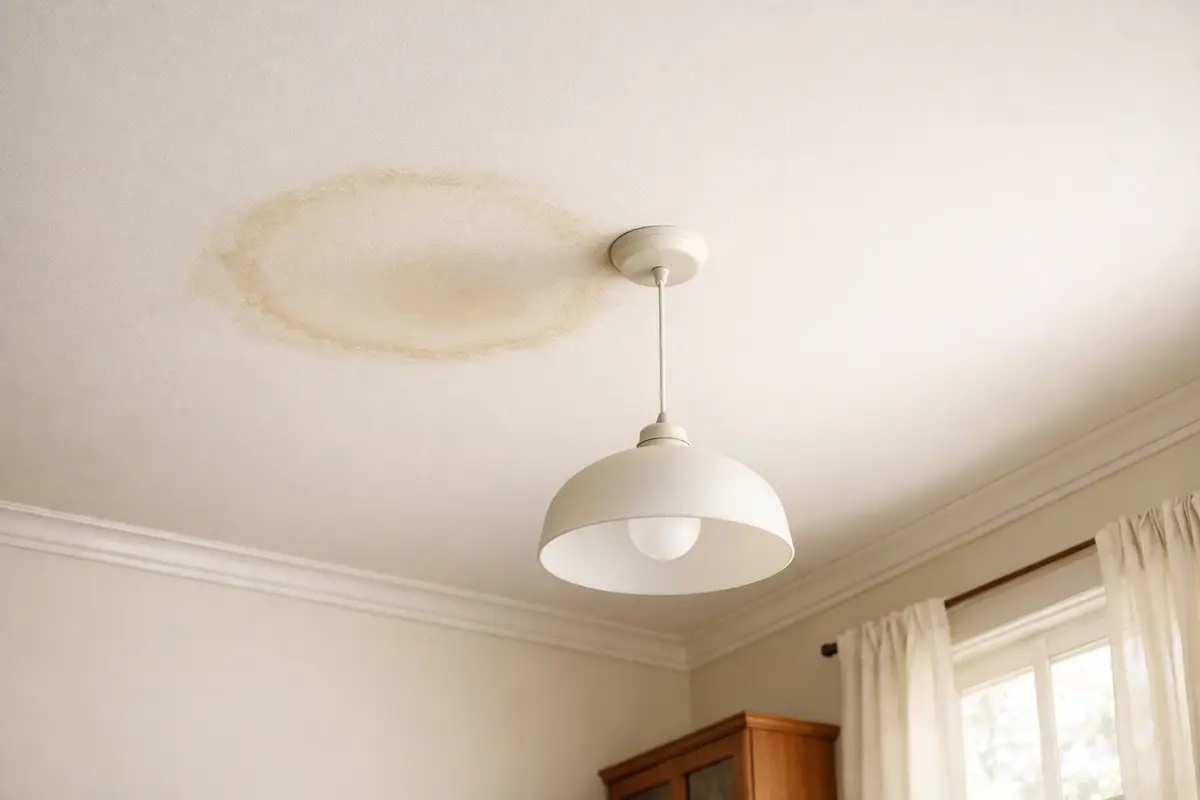
A brown or yellow patch on a ceiling says water has been there. It does not say how much, how long, or where it came from. Those are the questions the troubleshooter walks through, one at a time, and the first one is about safety, not diagnosis: is the ceiling wet or dripping now, and if it is, is the wet area around anything electrical?
The answer to that question matters because water and electrical equipment are a dangerous mix. The CDC's guidance for re-entering a flooded home is blunt about it: never turn power on or off yourself or use an electric tool or appliance while standing in water, and have an electrician check the system before power is restored. A leaking ceiling around a light fixture is not a flood, but the same logic applies, which is why that outcome is marked act now.
The questions after that
If the water is not near anything electrical, the next question is the source. This page cannot tell you whether your roof, your plumbing or condensation is the cause, and it says so. What it does is send you toward the right person: a plumber for a leak from above, a roofer for water coming through the roof or an outside wall, and ventilation fixes for condensation.
For condensation, the EPA's advice is to keep indoor relative humidity below 60 percent, ideally between 30 and 50 percent, to vent moisture sources outdoors, to run bathroom fans, and to insulate cold pipes. If a dry stain has no mold, the page tells you to watch it, because the key to mold control is moisture control and you want to know the water is really gone.
If there is visible mold, size is the next question. EPA says that if the moldy area is smaller than about 10 square feet, roughly 3 ft. by 3 ft., most people can do the cleanup themselves. For larger areas, or where the water damage is substantial, it advises consulting a professional experienced in mold cleanup. For sewage or other contaminated water, or when anyone has health concerns, the troubleshooter stops and sends you to a professional.
Worked example: a stain below a bathroom
A homeowner notices a brown ring on the bedroom ceiling below an upstairs bathroom. It is dry, with no mold visible. The first answer is that it is dry, then no visible mold, and the outcome is watch: she marks the edge of the stain in pencil and plans to check it after the bathroom is next used. Some weeks later the ring has grown and the paint feels damp. She returns to the page and answers that the ceiling is wet, that there is nothing electrical in the wet area, and that the source is a fixture above. The outcome is to stop the water, call a plumber, photograph before repairs, dry the area and throw out porous material that cannot be cleaned and dried. The sequence cost her nothing but attention, and the pencil mark did the diagnosing.
Mold and your insurer
If the leak was sudden, such as a burst pipe, tell your insurer and document everything before repairs. The Texas Department of Insurance guide says mold removal is generally excluded unless it is needed to repair a covered loss, and that continuous leaks are excluded, so the cause and the timeline matter. Is my damage covered? walks through those distinctions.
Related
The water damage checklist has the full drying and safety sequence, and sewage backup covers the contaminated-water case in more depth.
Sources
- EPA, A brief guide to mold, moisture and your home epa.gov
- EPA, Mold cleanup in your home epa.gov
- EPA, Flood cleanup to protect indoor air and your health epa.gov
- CDC, Safety guidelines: reentering your flooded home cdc.gov
- Homeowner's and renter's guide to mold cleanup after disasters (CDC-hosted, 2015) cdc.gov